
README.md 7.3 KB
Flask Black Dashboard
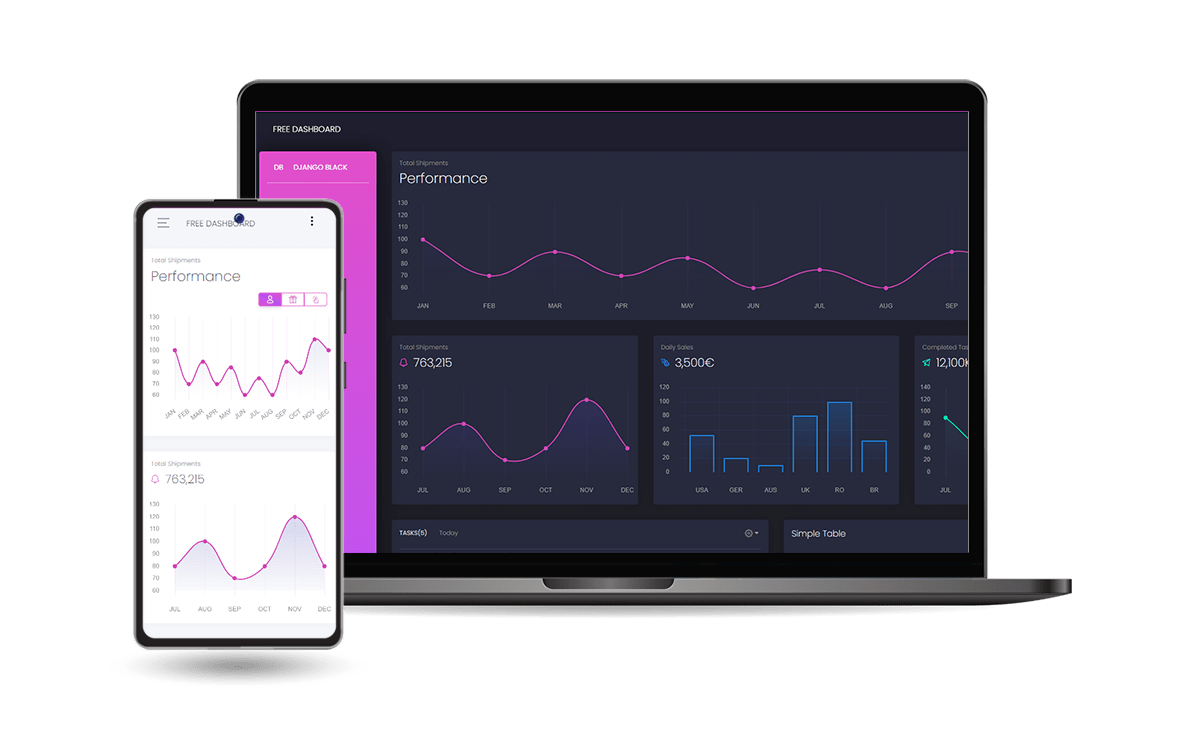
Open-source Flask Dashboard generated by AppSeed op top of a modern Bootstrap design. Designed for those who like bold elements and beautiful websites, Black Dashboard is ready to help you create stunning websites and webapps. Black Dashboard is built with over 50 frontend individual elements, like buttons, inputs, navbars, nav tabs, cards, or alerts, giving you the freedom of choosing and combining.
Context:
- Built with Black Dashboard Generator
- Timestamp:
2022-05-20 13:32 - Build ID:
fa2fcff5-2226-4e87-9700-21ef7b1b515d - Free Support (registered users) via
EmailandDiscord
Features
Up-to-date dependencies- Database:
MySql,SQLite DB Tools: SQLAlchemy ORM, Flask-Migrate (schema migrations)- Session-Based authentication (via flask_login), Forms validation
✨ Start the app in Docker
Step 1 - Download the code from the GH repository (using
GIT)
$ # Get the code
$ git clone https://github.com/app-generator/flask-black-dashboard.git
$ cd flask-black-dashboard
Step 2 - Edit
.envand setDEBUG=True. This will activate theSQLitepersistance.
DEBUG=True
Step 3 - Start the APP in
Docker
$ docker-compose up --build
Visit http://localhost:85 in your browser. The app should be up & running.
✨ Set up the MySql Database
Note: Make sure your Mysql server is properly installed and accessible.
Step 1 - Create the MySql Database to be used by the app
Create a new MySqldatabaseCreate a new userand assign full privilegies (read/write)
Step 2 - Edit the
.envto match your MySql DB credentials. Make sureDB_ENGINEis set tomysql.
DB_ENGINE:mysqlDB_NAME: default value =appseed_dbDB_HOST: default value =localhostDB_PORT: default value =3306DB_USERNAME: default value =appseed_db_usrDB_PASS: default value =pass
Here is a sample:
# .env sample

DEBUG=False                 # False enables the MySql Persistence

DB_ENGINE=mysql             # Database Driver
DB_NAME=appseed_db          # Database Name
DB_USERNAME=appseed_db_usr  # Database User
DB_PASS=<STRONG_PASS>       # Password
DB_HOST=localhost           # Database HOST, default is localhost
DB_PORT=3306                # MySql port, default = 3306
✨ How to use it
Download the code
$ # Get the code
$ git clone https://github.com/app-generator/flask-black-dashboard.git
$ cd flask-black-dashboard
👉 Set Up for Unix, MacOS
Install modules via
VENV
$ virtualenv env
$ source env/bin/activate
$ pip3 install -r requirements.txt
Set Up Flask Environment
$ export FLASK_APP=run.py
$ export FLASK_ENV=development
Start the app
$ flask run
At this point, the app runs at http://127.0.0.1:5000/.
👉 Set Up for Windows
Install modules via
VENV(windows)
$ virtualenv env
$ .\env\Scripts\activate
$ pip3 install -r requirements.txt
Set Up Flask Environment
$ # CMD
$ set FLASK_APP=run.py
$ set FLASK_ENV=development
$
$ # Powershell
$ $env:FLASK_APP = ".\run.py"
$ $env:FLASK_ENV = "development"
Start the app
$ flask run
At this point, the app runs at http://127.0.0.1:5000/.
👉 Create Users
By default, the app redirects guest users to authenticate. In order to access the private pages, follow this set up:
- Start the app via
flask run - Access the
registrationpage and create a new user:http://127.0.0.1:5000/register
- Access the
sign inpage and authenticatehttp://127.0.0.1:5000/login
✨ Code-base structure
The project is coded using blueprints, app factory pattern, dual configuration profile (development and production) and an intuitive structure presented bellow:
< PROJECT ROOT >
   |
   |-- apps/
   |    |
   |    |-- home/                           # A simple app that serve HTML files
   |    |    |-- routes.py                  # Define app routes
   |    |
   |    |-- authentication/                 # Handles auth routes (login and register)
   |    |    |-- routes.py                  # Define authentication routes
   |    |    |-- models.py                  # Defines models
   |    |    |-- forms.py                   # Define auth forms (login and register)
   |    |
   |    |-- static/
   |    |    |-- <css, JS, images>          # CSS files, Javascripts files
   |    |
   |    |-- templates/                      # Templates used to render pages
   |    |    |-- includes/                  # HTML chunks and components
   |    |    |    |-- navigation.html       # Top menu component
   |    |    |    |-- sidebar.html          # Sidebar component
   |    |    |    |-- footer.html           # App Footer
   |    |    |    |-- scripts.html          # Scripts common to all pages
   |    |    |
   |    |    |-- layouts/                   # Master pages
   |    |    |    |-- base-fullscreen.html  # Used by Authentication pages
   |    |    |    |-- base.html             # Used by common pages
   |    |    |
   |    |    |-- accounts/                  # Authentication pages
   |    |    |    |-- login.html            # Login page
   |    |    |    |-- register.html         # Register page
   |    |    |
   |    |    |-- home/                      # UI Kit Pages
   |    |         |-- index.html            # Index page
   |    |         |-- 404-page.html         # 404 page
   |    |         |-- *.html                # All other pages
   |    |
   |  config.py                             # Set up the app
   |    __init__.py                         # Initialize the app
   |
   |-- requirements.txt                     # App Dependencies
   |
   |-- .env                                 # Inject Configuration via Environment
   |-- run.py                               # Start the app - WSGI gateway
   |
   |-- ************************************************************************
✨ PRO Version
For more components, pages and priority on support, feel free to take a look at this amazing starter:
Black Dashboard is a premium Bootstrap Design now available for download in Django. Made of hundred of elements, designed blocks, and fully coded pages, Black Dashboard PRO is ready to help you create stunning websites and web apps.
- 👉 Black Dashboard PRO Flask - Product Page
- 👉 Black Dashboard PRO Flask - LIVE Demo

Flask Black Dashboard - Open-source starter generated by AppSeed Generator.